One week at Embassy Nouakchott down, two to go. I want to try avoid focusing too much on work here, as part of my effort to use caution with regards to what I put online for all to see, but I know people are curious, so I’ll give you a sense of what it is I’m doing here.
The Public Diplomacy section of the embassy is in charge of press relations as well as cultural activities. (This goes for all embassies, not just in Nouakchott). But as the name suggests, “Public Diplomacy” is very wide-ranging. The best explanation I’ve heard is this: while political officers work with government contacts, public diplomacy officers work with the rest of the population. Which means the responsibilities of the section range from press conferences and media interviews to english language support, women’s rights, encouraging democracy and good governance, and recruiting and selecting candidates for exchange programs (like Fulbright, for example).
A crucial part of all sections of our embassies are the LES (Locally Employed Staff). They generally represent most of the institutional knowledge at the embassy, since FSOs come and go every 2-4 years, but LES stay. Plus, since they are usually from the country where they’re working, they are invaluable to newbie FSOs like me who are desperately trying to get up to speed on local culture and customs!
The 6 local staff members of the PAS (Public Affairs Section) in Embassy Nouakchott are fantastic. They are friendly, eager, and passionate about the work they’re doing. They have been more than willing to explain the ins and outs of Mauritanian culture. Plus, they’re patient while I stumble and stutter my way through French 🙂
So as far as the job goes, in addition to reviewing grant proposals, interviewing candidates for exchange programs, writing remarks, etc, etc, a big chunk of time is spent on, well, public diplomacy. Which means going out into the real world and meeting with people. So far this has been the most interesting part. I have accompanied the PAO to several meetings with journalists, as well as to several English language groups. Not many people in Mauritania speak English, but people are really interested in learning it, so English clubs and classes really enjoy having native speakers to practice with.
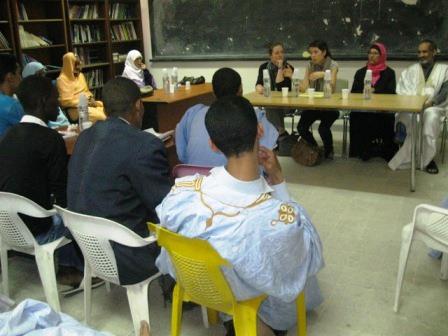 One afternoon, we spoke to two English classes back-to-back. One was at the American corner in a Mauritanian university (American Corners are Embassy-funded areas, like libraries or “corners” of libraries, where we provide American books and other materials for use by locals). Most of the students in the group had a really good command of English and were very vocal and interesting to talk to. The second English class was at the Islamic University in town, where they were equally vocal, but their English level was more basic. It was quite the challenge to remember to speak slowly and in simple sentences! Both groups of students were great – they were really enthusiastic and asked us lots of questions, and even when they touched on some more controversial policy stuff it was very good-natured. Thankfully I’m being afforded the luxury of easing my way into the “answering the tough questions” part of this job!
After those visits, I was let off the leash and sent to meet with the director of a new TV station, which has opened since Mauritania’s press freedom laws were liberalized about a year or so ago. The LES who liaises with members of the press went along with me, but as the American, I was expected to take the lead in the meeting. So I did. In French. I think they may have even understood what I said. At any rate, I spoke to the director for a while, who seems like he’s an aspiring Ted Turner-type. Really interesting guy. Then I was given a tour of the station – turns out they use the same editing software that we did at MSNBC – and ended up in a room full of the station staff. I was not expecting that at all, but apparently that’s how you roll in Mauritania – go with the flow. And it was great. The reason they sent me to this particular TV station was because of its uniqueness in that the majority of its employees are women, a rarity here, it seems. So I spent the next hour engaged in a Q & A with the women (and the handful of men, though they mostly remained quiet). It was really interesting to hear their perspective and learn about their struggles for equality – it’s really not so different from life in the U.S. just a few decades ago. I was able to share some of my experiences working for TV news back home, and all in all it was quite a successful and enjoyable afternoon.
I also have to mention just how invaluable the LES who accompanied me was. Many Mauritanians only speak Hassaniya (Arabic) and never learn French. This is especially common among women. So the session ended up being an amusing mix of my shaky French, their shaky French, Hassaniya translated into French, and my English translated into Hassaniya when the question called for a more nuanced answer than my French would allow me to give. Thanks to the trilingual local staff member accompanying me, it all worked out!
Next up – I am being dispatched to read picture books, in French, to small children. Most people who are reading this know my track record with small children. It is not extensive. New adventures!
Final thought: the cafeteria at the embassy is amazing. The fresh fish is to die for. Also, I have been introduced to bissap, a Senegalese hibiscus juice. It looks like grape juice and is kind of syrup-y, but it’s a really interesting, tasty flavor.
 Toto...We're Not In NYC Anymore
Wow! A busy week! Little children are generally very appreciative of good stories read with lots of expression. They are also very forgiving but truthful when asked their opinion. You will do a great job.